




Employee engagement is a metric that HR and leaders often place high on their list of priorities. The reason is simple: when employees understand their contribution, have clear expectations, feel supported, and have the ability to influence things, it directly translates into higher motivation, better collaboration, higher-quality outcomes, and lower turnover. It’s therefore no surprise that more and more organizations are choosing to measure engagement, either through annual surveys or regular pulse checks.
But the key question is what happens after the survey. Measurement alone does not create change. Too often, reports and results are simply “filed away.” The data is collected, the analysis is done, but concrete steps don’t follow. The results then become a formality, something we track, but don’t actively use for improvement.
“We certainly don’t want it to end up in a drawer again when the survey comes around in the autumn.”
Jolanda Luštrek, HR Director, Butan Plin
Why is it good to measure engagement?
A well-executed engagement survey helps an organization separate “feelings” from facts. Leaders may have a sense of how their team is doing, but personal impressions rarely capture the full picture. Even in one-on-one conversations or meetings, employees often won’t fully express their opinion, especially on sensitive topics such as trust in leadership, perceived fairness, workload, or unclear expectations.
"What you hear in the hallway may be a 'fairy tale'. If management doesn't have these 'rumours' backed up with evidence, with graphs, you have nothing."
Petra Frčej, HR Manager, MESI
If the survey is designed thoughtfully and ensures an appropriate level of anonymity, it can create a safe channel through which employees’ voices are more likely to be heard.
Another major value of measurement is that it helps focus on the right activities. Engagement is a broad concept, and without data we quickly drift into vague initiatives like “we need to improve the culture.” Data, on the other hand, shows whether the issue lies in communication, employee development, recognition, collaboration between teams, high workload, or something else.
Segment analysis allows us to also see where challenges are most pronounced. Sometimes the overall picture of the organization is positive, but one unit stands out with significantly lower scores. Without segmentation, this would be easy to miss.
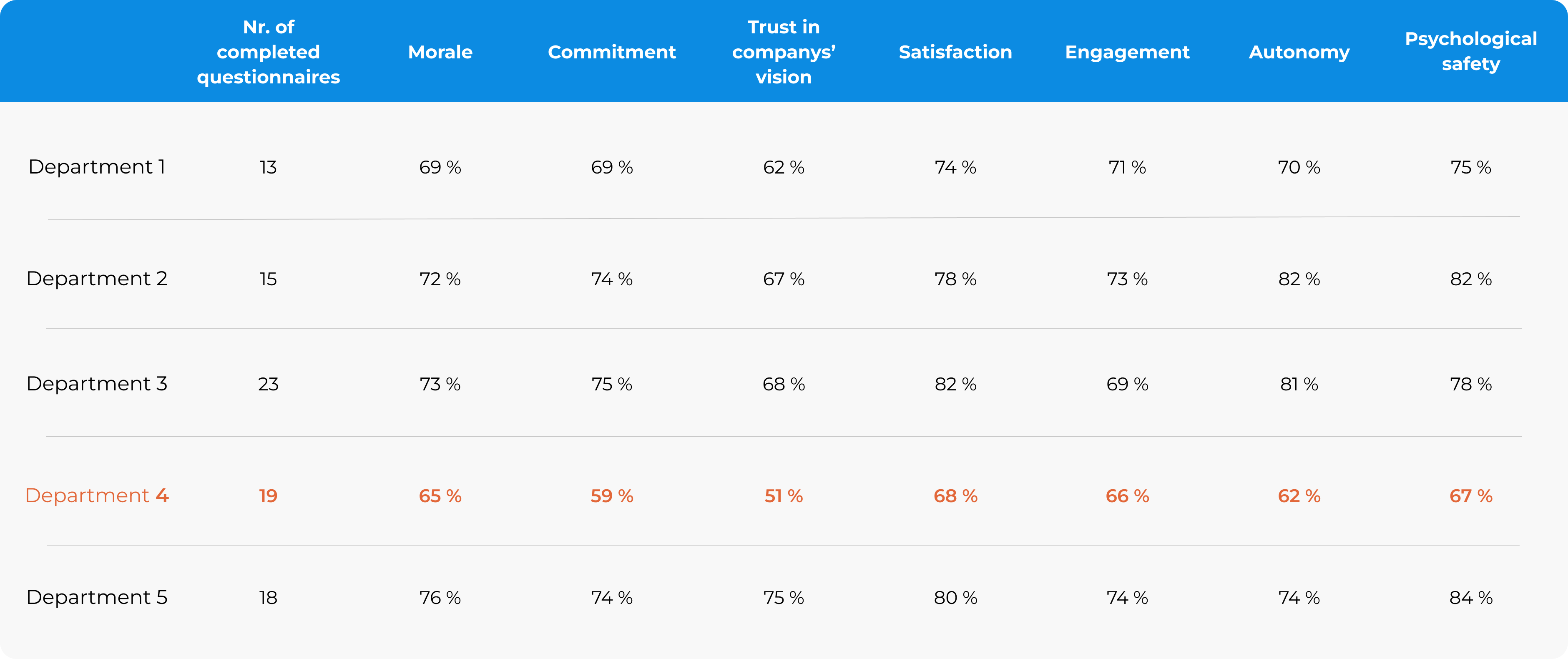
Surveys are also useful because they enable comparison over time. Engagement isn’t a “one-quarter project.” It’s the result of how work and leadership are practiced, so progress is often visible only in trends over time. Regular measurement therefore acts like a directional compass: it shows whether we’re moving in the right direction, even if changes haven’t fully taken hold in daily practice yet.
By participating in surveys, employees show they are willing to share their views and contribute to improvements. That’s a form of trust that must be honored with clear follow-up and concrete steps.
Why measurement alone won’t bring improvement
This is exactly where organizations most often get stuck in practice. We run the survey, receive a report that a few key people may skim, and then the pace of day-to-day work takes over. Meanwhile, employees wait.
If we ask employees for input and then do nothing, disappointment sets in quickly. Not because they expect instant change, but because they were invited to share their opinions and then saw no response. Gallup warns in its materials that a survey without follow-up can become counterproductive: engagement declines, turnover increases, and trust in the organization drops.
Employees draw a simple conclusion: “They ask us because they have to not because they actually want to improve anything.”
We often hear the term “survey fatigue,” but a better term might be “inaction fatigue.” Employees aren’t tired of being surveyed; they’re tired of nothing happening afterward. And once they believe surveys don’t lead to change, willingness to participate in future surveys declines as well, reducing data quality and pushing the organization into a vicious cycle.
That’s why it makes sense to see measurement as the start of a dialogue, not the end of an activity.
What we recommend after measurement: from data to trust
If we want a survey to become a lever for change, we need a clear process, simple enough for the organization to actually execute, and structured enough not to remain stuck at good intentions.
1. Understanding the data
The first step is to truly understand the data. That doesn’t mean analyzing every detail down to the last nuance, but identifying key patterns. It’s usually better to choose a few priorities and work on them thoroughly than to try to tackle everything at once. It helps to focus on trends: what is improving, what is staying the same, and where the largest differences between teams appear.
2. Alignment with leadership
The second step is alignment with leadership. Engagement isn’t just an HR initiative, it’s a strategic topic, so it needs clear support from decision-makers, both in terms of resources and priorities and in consistent, transparent communication. If actions require collaboration with other functions (e.g., IT, finance, operations), leadership must commit to helping ensure their involvement.
3. Sharing results with employees
The third step is sharing results with employees. This is often overlooked, yet it’s one of the strongest building blocks of trust. Transparency doesn’t mean showing every number down to the last decimal point, it means clearly telling employees what we recognized: what the strengths are, where the challenges lie, and, most importantly, what will happen next. The key message should be that we’re not looking for someone to blame, but looking as a team for concrete next steps.
“We told employees in advance that all steps would be transparent and that feedback would also come from Quantifly—so they were really looking forward to it.”
Urša Ferlic, HR consultant, Briefd
4. Workshops to create action plans
The most important next step is workshops to create team-level action plans. This is often where the shift happens from “this is leadership’s problem” to “this is something we co-create.”
A good workshop isn’t simply a meeting where a manager writes a to-do list for themselves. It’s a space where the team first understands the results, then chooses 1–2 focus areas and agrees on concrete steps. It helps to frame questions around experiences and behaviors: “How does this show up in our day-to-day work? What helps us? What gets in our way? And what can each of us do differently to improve it?”
“Based on these insights, we were able to guide meaningful conversations with employees and jointly create action plans tailored to their specific needs. The support from Quantifly made the process structured and efficient.”
Nuša Zajc Demšar, HR generalist Butan Plin
To ensure agreements don’t stay on paper, ownership is crucial. It’s very important to assign an “action item leader” for each step, someone responsible for each action. The responsible person isn’t “the one who does everything,” but the one who ensures progress: that steps are clear, that resources are available, and that the team regularly checks progress.
For each measure, it’s important to define:
- what the results were and what they stem from,
- what we will do (step by step),
- who is responsible (for each step),
- by when it will be done, and
- how we will know it’s working.
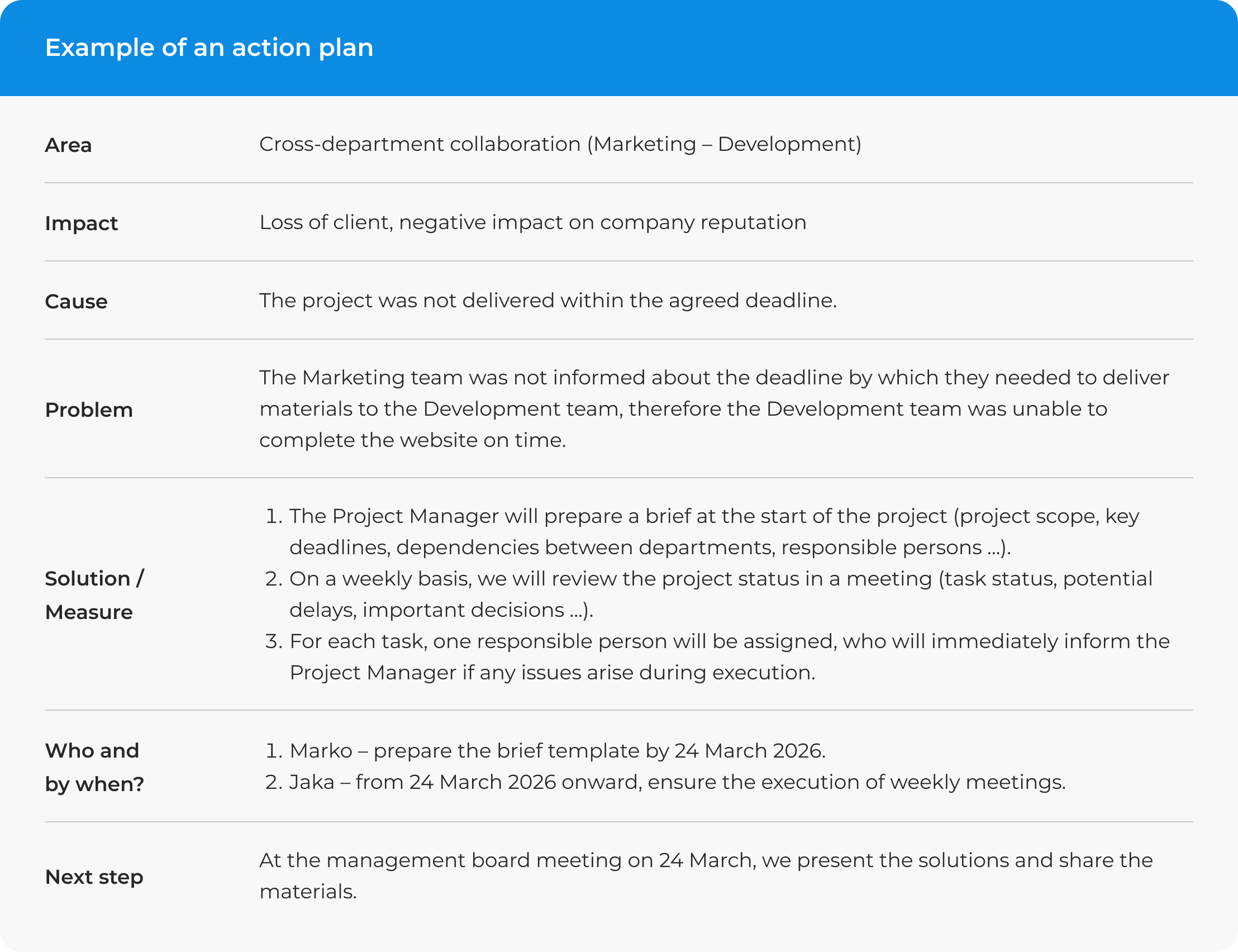
A highly effective element at this stage are also “quick wins”. Small, visible improvements (e.g., clearer weekly communication, agreement on priorities, a simple process fix) show that the organization takes feedback seriously. When employees see a direct link between feedback and change, positive momentum starts to build.
5. Monitoring and evaluation
The final important step is monitoring and evaluation. If after a month or two we don’t check whether actions are working, we might be doing a lot without moving the right things forward. It makes sense to run a short pulse check or a targeted impact review, and then adjust actions accordingly.
“Repeating the analysis after a certain period definitely makes sense, so we can see whether we managed to address the problems.”
Rebeka Tramšek, Head of HR, Elpro Križnič
Conclusion
Measuring engagement is important because it provides direction. But that’s only the first half of the story. The second half is action, and that’s what builds trust, changes everyday reality, and improves the employee experience in the long term.
Employees don’t expect perfect solutions. They need proof that their voice matters. When measurement becomes part of a continuous improvement cycle (measure → act → check → adjust), engagement is no longer just a number in a report, it becomes something people can truly feel within the organization.
.png)